Books
Quantum Machine Learning - Theory, Algorithms, and Practical Implementation

Publisher: CRC Press
Published: Aug. 1, 2026
ISBN: 9781041364511
Quantum machine learning has emerged as a rapidly developing field at the intersection of quantum computing, artificial intelligence, and data science. As the quantum hardware and algorithms continue to advance, there is a growing need for a rigorous and accessible text that explains how quantum principles can be used to design, analyze, and implement machine learning models. This book is intended for graduate students, researchers, and practitioners in computer science, physics, engineering, mathematics, and related disciplines.
The book provides a comprehensive introduction to the foundations and modern methods of quantum machine learning. It begins with the principles of quantum information, Hilbert spaces, quantum circuits, and quantum algorithms relevant to learning tasks, and then develops the major paradigms of the field, including quantum data encoding, quantum feature maps and kernels, variational quantum circuits, quantum neural networks, quantum generative models, quantum reinforcement learning, quantum transfer learning, and quantum linear algebra techniques. The text emphasizes both theory and implementation, with programming examples and computational workflows using Qiskit, PennyLane, TensorFlow Quantum, and PyTorch. Additional chapters address tensor-network-inspired learning, error mitigation, GPU-accelerated simulation, benchmarking, hybrid quantum-classical architectures, and applications in chemistry, genomics, finance, optimization, and natural language processing.
Distinctive in both scope and organization, the book integrates mathematical foundations, algorithmic development, software implementation, and emerging research directions within a single coherent framework, making it suitable both as a graduate-level textbook and as a practical reference for researchers working in quantum machine learning.
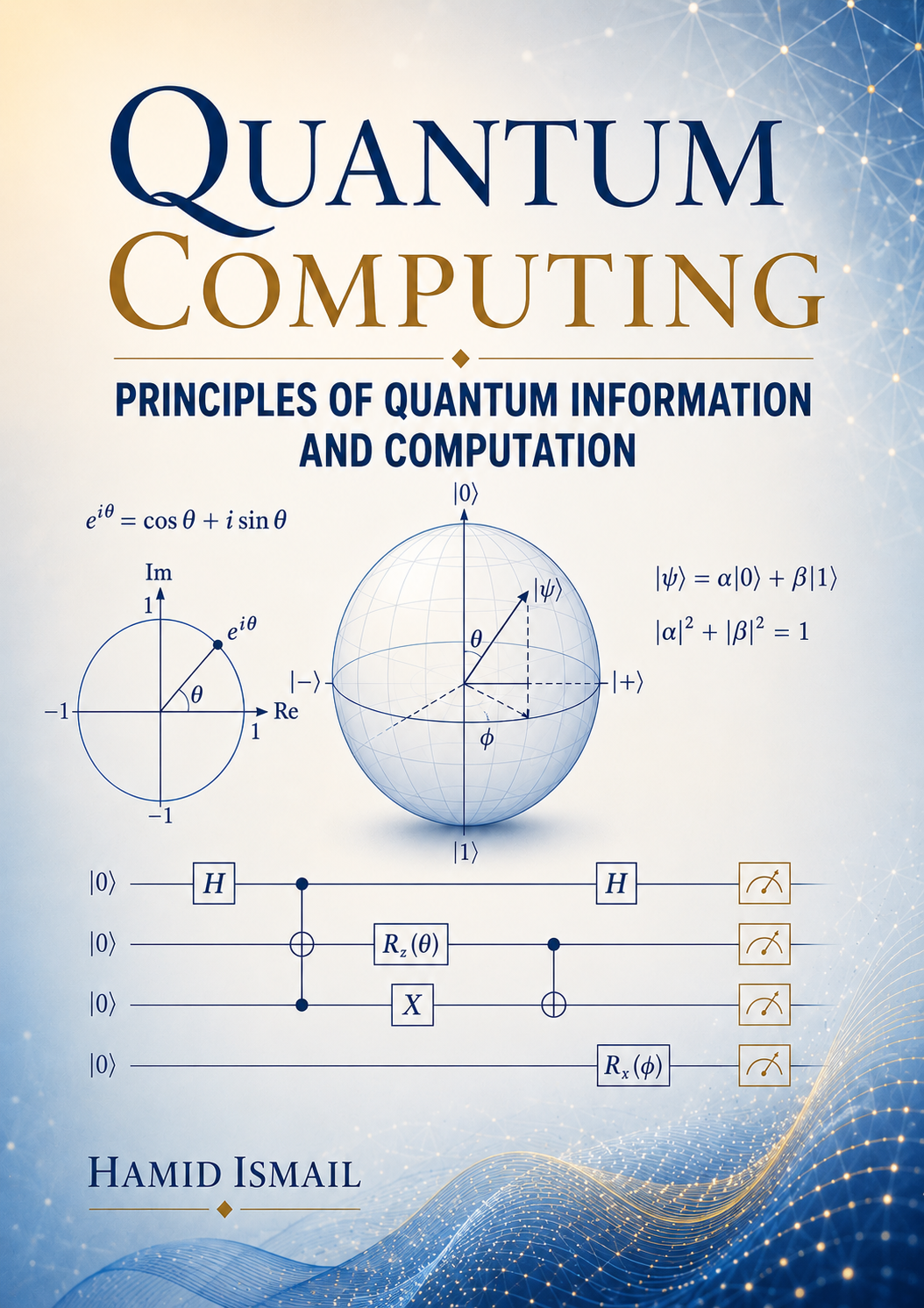
Quantum Computing: Principles of Quantum Information and Computation
Publisher: CRC Press
Published: June 12, 2026
ISBN: TBD
Quantum Computing: Principles of Quantum Information and Computation provides a comprehensive introduction to the foundations, principles, and practical implementation of quantum computing. Intended for senior undergraduate students, graduate students, researchers, and professionals, the book presents a unified framework that connects the mathematics of quantum mechanics with quantum information and quantum algorithms. Rather than treating these topics as isolated subjects, the text develops them as successive stages of a coherent intellectual journey from mathematical foundations to modern quantum applications.
Beginning with complex numbers, linear algebra, and Hilbert spaces, the book develops quantum states, quantum evolution, measurement, superposition, entanglement, phase, and interference before introducing the Quantum Fourier Transform and the fundamental paradigms of quantum algorithms. It then presents several of the most influential quantum algorithms, including the Bernstein–Vazirani algorithm, Quantum Phase Estimation, Shor's algorithm, and Grover's algorithm, followed by discussions of quantum simulation, variational algorithms, quantum communication, quantum cryptography, quantum error correction, fault-tolerant quantum computing, and emerging directions in quantum information science.
A distinguishing feature of the book is its integration of conceptual understanding with practical implementation. Every major concept is developed from first principles, explained intuitively, and reinforced through worked examples and Qiskit implementations. To ensure long-term relevance, all executable code is maintained in a continuously updated GitHub repository, allowing the printed text to remain focused on enduring concepts while software implementations evolve over time.
By emphasizing understanding before formalism and intuition before complexity, this book aims to demystify quantum computing and provide readers with a solid foundation for further study, research, and application in quantum information science.
Bioinformatics of Autoimmune Diseases

Publisher: Chapman and Hall/CRC
Published: Feb. 12, 2026
ISBN: 9781041166115
Autoimmune disorders are among the most complex and challenging diseases in medicine, arising when the immune system mistakenly targets the body’s own cells and tissues. Autoimmune Disorders: Science and Bioinformatics offers a comprehensive exploration of the immunological, genetic, molecular, and computational foundations of autoimmunity. The book begins with an in-depth overview of immune system architecture, distinguishing the innate and adaptive branches and detailing the molecular mechanisms of immune activation, regulation, and tolerance. It presents a rigorous analysis of key immune components, including antigen-presenting cells, T and B lymphocytes, major histocompatibility complexes, cytokines, chemokines, and immune checkpoints. It highlights how their dysregulation leads to pathological self-reactivity. Through the lens of modern genomics and immunology, the text investigates the multifactorial nature of autoimmune disease etiology, from genetic predisposition and environmental triggers to epigenetic modifications and molecular mimicry. Case studies of major autoimmune diseases such as rheumatoid arthritis, systemic lupus erythematosus, and type 1 diabetes illustrate how advances in immunogenetics, bioinformatics, and systems biology are unraveling disease mechanisms and informing novel diagnostic and therapeutic strategies. Designed for researchers, clinicians, and students, this book bridges classical immunology with contemporary computational biology. By integrating mechanistic insights with computational frameworks, it charts a path toward precision medicine in the diagnosis and treatment of autoimmune disorders.
Bioinformatics A Practical Guide to Next Generation Sequencing Data Analysis

Publisher: Chapman and Hall/CRC
Published: June 29, 2023
ISBN: 978-1032408910
Bioinformatics: A Practical Guide to Next Generation Sequencing Data Analysis contains the latest material in the subject, covering NGS applications and meeting the requirements of a complete semester course. This book digs deep into analysis, providing both concept and practice to satisfy the exact need of researchers seeking to understand and use NGS data reprocessing, genome assembly, variant discovery, gene profiling, epigenetics, and metagenomics. The book does not introduce the analysis pipelines in a black box, but with detailed analysis steps to provide readers with the scientific and technical backgrounds required to enable them to conduct analysis with confidence and understanding. The book is primarily designed as a companion for researchers and graduate students using sequencing data analysis, but will also serve as a textbook for teachers and students in biology and bioscience.
Bioinformatics A Practical Guide to NCBI Databases and Sequence Alignments

Publisher: Chapman and Hall/CRC
Published: March 23, 2022
ISBN: 9781032128740
Bioinformatics: A Practical Guide to NCBI Databases and Sequence Alignments provides the basics of bioinformatics and in-depth coverage of NCBI databases, sequence alignment, and NCBI Sequence Local Alignment Search Tool (BLAST). As bioinformatics has become essential for life sciences, the book has been written specifically to address the need of a large audience including undergraduates, graduates, researchers, healthcare professionals, and bioinformatics professors who need to use the NCBI databases, retrieve data from them, and use BLAST to find evolutionarily related sequences, sequence annotation, construction of phylogenetic tree, and the conservative domain of a protein, to name just a few. Technical details of alignment algorithms are explained with a minimum use of mathematical formulas and with graphical illustrations.
Statistical Modeling, Linear Regression and ANOVA, A Practical Computational Perspective

Publisher: Lulu
Published: July 7, 2021
ISBN: 978-1387205516
Statistical modeling is a branch of advanced statistics and a critical component of many applications in science and business. This book is an attempt to satisfy the need of mathematical statisticians and computational students in linear modeling and ANOVA. This book addresses linear modeling from a computational perspective with an emphasis on the mathematical details and step-by-step calculations using SAS® PROC IML. This book covers correlation analysis, simple and multiple linear regression, polynomial regression, regression with correlated data, model selection, analysis of covariance (ANCOVA), and analysis of variance (ANOVA). The level is suitable for upper level undergraduate and graduate students with knowledge of linear algebra and some programming skills.